On this page
- What is a Dual SIM Router and Why Did It Exist?
- The Single SIM Problem – and How It Was Solved Differently
- Multi-Network and Multi-IMSI SIM Cards: Redundancy Without the Second Slot
- eSIM and SGP.32: The Embedded Revolution
- Is “Dual SIM Router” Still the Right Term?
- The Future Form Factor: Does the Router Still Need to Be a Router?
- The Role of IoT Antennas – Still Non-Negotiable
- Where to Go Next
- Summary: The Evolution of Multi-Network Industrial Connectivity
The term dual SIM router has been part of industrial IoT vocabulary for over a decade. It appears in product specs, procurement documents, tender requirements, and installer checklists across the UK and Europe. But the technology it describes is changing fast – and the question of whether the term itself survives the next five years is a genuinely interesting one.
This post looks at where dual SIM came from, what it actually solves, how eSIM and multi-network IoT SIM cards are changing the picture, and what industrial cellular connectivity might look like in the next generation of devices.
What is a Dual SIM Router and Why Did It Exist?
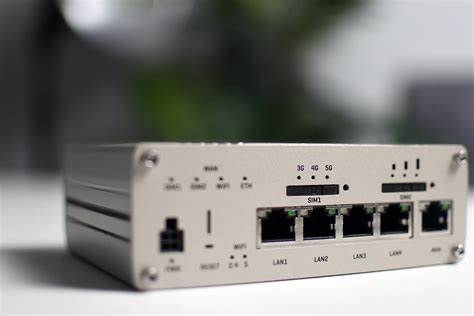
A dual SIM router is an industrial cellular router with two physical SIM card slots. The original purpose was straightforward: carrier redundancy. If your primary network provider lost signal or had an outage, the router would switch to the SIM in slot two – on a different network – and keep the connection alive.
In the early days of industrial 4G deployments, this mattered enormously. UK mobile networks were less mature, coverage was patchier, and the idea of relying on a single carrier for a mission-critical connection at a remote pump station or unmanned CCTV cabinet was genuinely risky. Two SIMs, two networks, automatic failover. Simple logic.
The dual SIM router became standard issue for any deployment where downtime had a cost. SCADA systems, EV chargers, building management, remote telemetry, ATMs, payment kiosks. If the connection going down meant lost revenue, failed transactions, or a safety issue, you put two SIMs in the router and slept better.
Teltonika Networks built much of their reputation on exactly this. The RUT950 and RUT951 became trusted workhorses in UK industrial IoT deployments precisely because of their reliable dual SIM failover. The current generation – the RUT901, RUT956, and RUTX50 – all carry dual SIM as a core feature.
The Single SIM Problem – and How It Was Solved Differently
Not every deployment justifies a dual SIM router. For low-cost, low-risk remote monitoring nodes – a sensor in a car park, a digital sign in a retail unit, a door access controller in a small office – a single SIM router with a reliable IoT SIM was perfectly adequate. Simpler hardware, lower cost, easier installation.
The Teltonika RUT200 is the obvious example. Single SIM, compact, cost-effective, runs the full RutOS stack. For the majority of straightforward IoT connectivity applications, it is exactly enough. You do not need dual physical SIM slots if the single SIM you are using is already multi-network.
That last point is where the story gets interesting.
Multi-Network and Multi-IMSI SIM Cards: Redundancy Without the Second Slot
The fundamental problem that dual SIM solved was network dependency. Lock your device to a single carrier, and that carrier’s coverage gaps become your coverage gaps. Their outages become your outages.
Multi-network roaming IoT SIM cards attack that problem from a different direction. Instead of two SIMs on two networks, you have one SIM that connects to multiple networks. In the UK, a properly specified multi-network IoT SIM will roam across EE, O2, Vodafone, and Three – selecting the strongest available signal automatically, without any failover logic in the router. The SIM itself handles the network selection.
Multi-IMSI SIM cards take this further. Rather than using a single IMSI that roams, a multi-IMSI SIM carries multiple international mobile subscriber identities from different operators. The device can switch between them based on signal quality, geography, or policy. For global deployments crossing multiple regulatory environments, this is significant.
The practical effect: a single-SIM router running a good multi-network IoT SIM already has much of the resilience that a dual physical SIM was designed to provide. The second slot becomes less critical when the first slot is already network-agnostic.
eSIM and SGP.32: The Embedded Revolution
The next layer of this evolution is eSIM – the embedded SIM that replaces the physical card entirely.
The GSMA’s SGP.02 standard (M2M eSIM) has been around for years. It allows operator profiles to be provisioned and switched remotely, without physically accessing the device. For industrial deployments in sealed enclosures, rooftop cabinets, or buried infrastructure, this is transformative. No site visit to swap a SIM. No physical card to fail or corrode. Profile changes pushed remotely via the SM-SR/SM-DP infrastructure.
SGP.32 – the GSMA’s IoT-specific eSIM standard – goes further. It is designed specifically for the constraints of IoT devices: low power, intermittent connectivity, minimal processing overhead. It simplifies the M2M profile management architecture and makes remote provisioning practical at scale for constrained devices. Where SGP.02 assumed enterprise-grade connectivity during profile operations, SGP.32 is designed to work in the real conditions IoT devices actually experience.
Teltonika’s newer models already reflect this direction. The RUT241 combines a physical nano SIM slot with an embedded eSIM – giving it effectively two independent paths using a single physical card slot and an onboard eSIM module. The RUTM30 goes further with dual physical SIM slots plus embedded eSIM – three independent connectivity pathways in one compact unit.
From a connectivity resilience standpoint, the RUTM30 with a multi-network IoT SIM in each physical slot and an eSIM profile loaded for a third operator is more resilient than a traditional dual SIM router ever was. The hardware has moved ahead of the terminology.
Is “Dual SIM Router” Still the Right Term?
Here is where the semantics get interesting. The term dual SIM router describes a physical hardware characteristic – two SIM slots. But what engineers and procurement teams actually want is network resilience, carrier independence, and the ability to maintain connectivity when one path fails.
Those requirements are increasingly being met by combinations of eSIM, multi-IMSI SIMs, and embedded cellular modules that do not map neatly onto the dual physical SIM model.
Consider the current state:
A RUT200 with a multi-network roaming SIM has practical multi-network resilience from a single slot. Is it a dual SIM router? No. Does it provide meaningful carrier redundancy? Often, yes.
A RUT241 with a physical SIM and an active eSIM profile has two independent network paths. Is it a dual SIM router? It has two SIM identities but one physical slot. The traditional label does not quite fit.
A RUTM30 with dual physical SIM, embedded eSIM, and a multi-IMSI profile loaded has resilience that exceeds anything a traditional dual SIM router could offer. What do you call it?
The industry has not fully settled on new language yet. Terms like multi-path, multi-network, multi-SIM, and hybrid SIM appear in product documentation but none has become the standard descriptor. For now, dual SIM router persists in procurement language because it is familiar and understood – even as the underlying technology it describes evolves beyond it.
The Future Form Factor: Does the Router Still Need to Be a Router?
The longer view raises a more fundamental question. As eSIM modules become smaller, cheaper, and more capable, and as industrial Ethernet switches and serial interface modules mature, is the integrated router form factor still the right answer for industrial IoT connectivity?
There is a credible future in which the cellular connectivity function is disaggregated. An eSIM module – essentially a cellular modem with eUICC and SGP.32 support – connects to an existing managed switch or serial interface panel as a WAN uplink. Configuration and profile management happens remotely via a cloud platform. The switch handles all the local LAN functions it already handles. The cellular module provides the WAN. No integrated router required.
This model already exists in embryonic form in the Teltonika TRB series of compact cellular gateways – the TRB140 (Gigabit Ethernet gateway), TRB145 (RS485), and TRB255 (RS232/RS485) – which are essentially cellular modems with minimal routing capability, designed to add cellular connectivity to existing network infrastructure rather than replace it.
The fully disaggregated version of this – an eSIM module that clips onto a DIN rail and presents a standard WAN Ethernet interface to whatever switch or router is already installed – is not far away. For new infrastructure builds, the integrated industrial router will remain the default for simplicity and RMS manageability. For retrofit and brownfield applications, disaggregated cellular connectivity modules will increasingly make sense.
What remains constant across all of this is the RutOS ecosystem and Teltonika RMS. Whatever the hardware form factor, the management plane – firmware updates, configuration, monitoring, VPN access, signal metrics – is what makes large-scale IoT deployments manageable. The value of a unified management platform grows as the hardware diversifies.
The Role of IoT Antennas – Still Non-Negotiable
One thing that does not change with any of this evolution: antenna quality matters, and it matters more than most deployment guides acknowledge.
An eSIM module with three active network profiles is still limited by the RF signal it receives. A router with dual SIM failover will failover to a weak signal and deliver a poor connection. The antenna is the first link in the chain, and a poor antenna decision undermines everything downstream.
For industrial deployments, the default stub antennas supplied with routers are a starting point, not a finished installation. Applications that require genuine reliability – SCADA, EV charging, CCTV, solar site telemetry – should use external antennas matched to the frequency bands and MIMO configuration of the router and the dominant networks at the site.
Key considerations: antenna gain appropriate to the installation environment, MIMO configuration matching the router’s modem (2×2 for most 4G Cat 4 deployments, 4×4 for higher-category modems and 5G), cable loss minimised by keeping runs short or using low-loss cable, and physical placement that maximises sky view and minimises near-field interference from metal enclosures and mains cabling.
As 5G deployments expand and higher-band sub-6 GHz frequencies become more relevant, antenna selection becomes more complex. A wideband antenna covering 600 MHz to 6 GHz is no longer exotic – it is practical for deployments that will run for five to ten years and need to accommodate network evolution without hardware changes.
Where to Go Next
If you are specifying Teltonika routers for a current deployment and want a practical breakdown of which model suits which application – covering the RUT200, RUT241, RUT901, RUTX50, RUTM30, and RUT956, along with RMS and IoT SIM card guidance – The Router Store has published a detailed guide: Top Six Teltonika Routers From The Router Store.
The Router Store is a Teltonika Diamond Partner supplying the full range of Teltonika routers, matched antennas, and IoT SIM cards from UK stock with next-working-day delivery.
Summary: The Evolution of Multi-Network Industrial Connectivity
The dual SIM router solved a real problem – carrier dependency – with available technology: two physical SIM slots. That solution worked, and for many applications it still works well.
But the problem itself is being solved more elegantly by multi-network roaming SIMs, multi-IMSI profiles, embedded eSIM with SGP.32 remote provisioning, and hardware that combines physical and embedded SIM in the same device. The RUT241’s physical-plus-eSIM architecture and the RUTM30’s triple-path connectivity are not marketing features. They are the practical outcome of this convergence.
The term dual SIM router will persist in procurement language for years, because familiar language outlasts the technology it describes. But the underlying requirement – resilient, network-agnostic, remotely manageable cellular connectivity for industrial IoT applications – is already being delivered by hardware that the old label does not fully capture.
The next generation of industrial cellular connectivity will probably not look like a router at all. It will look like a managed cellular uplink module in a standards-compliant enclosure, provisioned remotely, managed via cloud, and connected to whatever switching and interface hardware the application requires. The antenna will still matter. The management platform will still matter. The physical SIM slot may not.
[…] For the full picture on how these models fit together and which application suits which router, the dual SIM router guide at 5grouters.co.uk is a useful […]