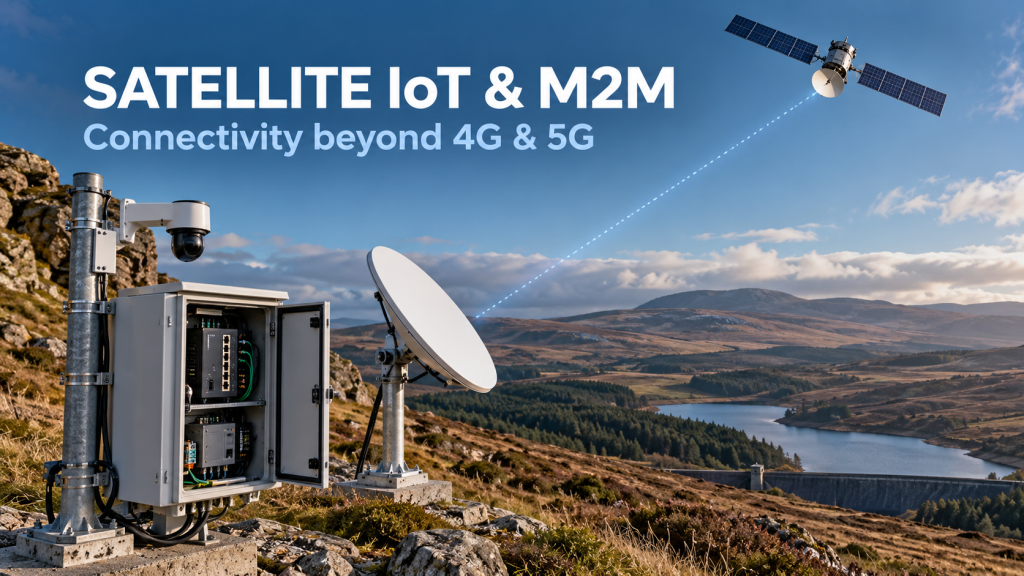
When a remote site has no fibre, no copper and no usable 4G or 5G signal, the usual answer has been to give up on connecting it, or to pay for an expensive bespoke link. Satellite IoT changes that. A managed geostationary satellite service now gives remote equipment its own always-on IP internet connection from £30.50 per month + VAT for 10GB, with the Hughes satellite terminal included in the monthly price and professional installation available. This guide explains how satellite M2M works, where it fits alongside a 5G router, and why it is quietly becoming one of the most cost-effective ways to connect remote IoT equipment in the UK.
Satellite IoT at a glance
| What it is | A managed satellite IP connection for IoT and M2M equipment, delivered over a Eutelsat geostationary (GEO) satellite |
|---|---|
| Price | From £30.50 per month + VAT (10GB plan), plus one-off professional installation |
| Data | 10GB per month included, with larger plans and data bolt-ons available |
| Speed | Up to 10 Mbps download / 5 Mbps upload (maximum information rate) |
| Hardware | Hughes Class 8 satellite terminal included in the monthly price |
| Support | Network Operations Centre (NOC) service desk support and a Service Level Agreement |
| Term | 12 months |
| Coverage needed | None from mobile networks, just a clear view of the satellite in the southern sky |
| Connects to | Any Ethernet/IP device: 5G and 4G routers, PLCs, RTUs, CCTV recorders, IoT gateways and PCs |
What is satellite IoT?
Satellite IoT is the use of satellite links to connect Internet of Things and machine-to-machine (M2M) equipment that sits beyond the reach of fixed broadband and mobile networks. The term covers two very different things, and the difference matters when choosing a solution:
- Satellite IoT messaging: devices with a built-in satellite modem send small messages of a few bytes or kilobytes. Ideal for asset trackers and simple sensors, but there is no real internet connection, no remote access and no way to plug in existing equipment.
- Satellite M2M connectivity: a satellite terminal on site provides a full IP internet connection with gigabytes of monthly data. Your existing router, PLC, camera or gateway plugs in by Ethernet and works exactly as it would on fibre or 4G.
This article is about the second type. It is not satellite messaging. It is an IP internet connection for remote equipment, and that is what makes it so useful.
Why satellite M2M is a breakthrough for remote IoT
Anyone who has deployed remote equipment knows the routine. No fibre? Try 4G. Weak 4G? Try a dual SIM router or a multi-network SIM. Still nothing? Until recently the options became expensive very quickly. Satellite M2M breaks that pattern:
- Connect almost anywhere. If the site has a clear view of the southern sky, it can be online. Hilltops, moorland, reservoirs, farms, forestry, solar farms and roadside cabinets all become connectable.
- No mobile coverage required. The service does not depend on EE, O2, Vodafone or Three. Mobile not-spots stop being a project blocker.
- No fixed line required. No waiting for a line installation, no digging and no reliance on ageing copper.
- Remarkably low running costs. From £30.50 per month + VAT for 10GB, which is close to the price of a business IoT SIM plan, yet it includes a complete managed satellite bearer and the terminal.
- No hardware purchase. The Hughes Class 8 terminal is included in the monthly price, so there is no separate satellite hardware bill to approve.
- Your equipment does not need to understand satellite. The terminal handles the satellite link and hands over an ordinary Ethernet connection. Nothing on site needs a satellite modem.
- Managed and supported. NOC service desk support and an SLA come as standard, which matters for operational and critical infrastructure.
- Genuine diversity from mobile networks. Satellite uses completely different infrastructure from terrestrial networks, so a local mobile outage does not take it down.
How satellite M2M works
The service uses a geostationary (GEO) satellite. A geostationary satellite orbits roughly 35,786 km above the equator at the same speed the Earth turns, so it appears fixed in the sky. That single fact is why GEO satellite is so simple and economical for fixed IoT sites: the dish is aligned once during installation and then left alone, with no tracking motors and no moving parts.
- Survey and install. An engineer surveys the site, confirms line of sight to the satellite and mounts the dish on a wall, pole or ground mount.
- Align and commission. The dish is pointed at the Eutelsat satellite and the Hughes terminal is activated and tested.
- Plug in by Ethernet. The terminal connects to your router or switch as its WAN connection.
- Monitored service. The link is backed by NOC service desk support and an SLA.
From the point of view of your router, the satellite terminal is simply another WAN connection, like a fibre ONT or a DSL modem.
Satellite and 5G routers: better together
This is where satellite IoT becomes especially powerful for anyone already using an industrial 5G router. Most industrial 4G and 5G routers support a wired Ethernet WAN alongside their cellular modem, so a satellite terminal can plug straight in. That gives three practical designs:
| Design | How it works | Best for |
|---|---|---|
| Satellite only | Satellite terminal is the router’s only WAN | Sites with no usable mobile coverage at all |
| 5G + satellite failover | 5G or 4G is the everyday link; the router fails over to satellite automatically if cellular drops | Sites where downtime is costly and cellular coverage is present but not dependable |
| Multi-network 5G + satellite | Dual SIM or multi-network cellular plus satellite as an independent third path | Critical infrastructure needing maximum WAN diversity |
The failover design is the natural upgrade for any 5G backup router deployment. Cellular and satellite share no infrastructure: a mast outage, a regional network fault or a damaged cable on the mobile side does not affect the satellite path. The router’s own failover, policy routing and VPN features keep remote management working whichever bearer is in use.
Where satellite IoT is used
- Telemetry and SCADA: PLCs, RTUs, pumps, tanks, meters and remote control systems.
- Remote CCTV and security: cameras, ANPR and alarms on sites with no fixed or cellular backhaul. See also our guide to the 5G router for CCTV.
- Water and utilities: reservoirs, pumping stations, treatment works and outstations.
- Energy and renewables: solar farms, wind turbines, battery storage and substations.
- Environmental monitoring: weather stations, flood gauges, air quality and river level sensors.
- Agriculture and estates: irrigation, livestock monitoring, remote buildings and land management.
- Construction: temporary sites, welfare units, site security and monitoring.
- Out-of-band management: an independent management path into remote network infrastructure when the primary connection fails.
Satellite IoT pricing
Satellite IoT is available from £30.50 per month + VAT for the 10GB plan, on a 12-month term. That includes:
- 10GB of satellite data every month
- Up to 10 Mbps download / 5 Mbps upload
- Hughes Class 8 satellite terminal
- Eutelsat GEO satellite service
- NOC service desk support
- Service Level Agreement
Installation is a one-off professional charge per site, quoted after a site survey. Larger data plans, unlimited plans and data bolt-ons are available for sites that need more than 10GB a month.
For context, 10GB a month is plenty for most IoT workloads. SCADA polling, meter reads and sensor data typically use megabytes rather than gigabytes, leaving generous headroom for remote access, firmware updates and CCTV event clips.
Is satellite right for your application?
Satellite M2M is a superb fit for most remote IoT, but it is worth being clear about one characteristic of geostationary satellite: latency. Because the signal travels to a satellite around 35,786 km away and back, round-trip latency is typically around 600 ms or more.
- Excellent for: telemetry, SCADA polling, meter and sensor data, remote access and configuration, VPN management, CCTV event uploads and on-demand viewing, software and firmware updates.
- Not ideal for: real-time control loops that need very fast responses, or latency-sensitive voice and video calling.
If your application needs inbound connections, such as viewing cameras directly or reaching a PLC from outside, mention it at survey stage so the right IP addressing option can be confirmed. Our guide to 5G router public IP explains why addressing matters for remote access.
What a site needs for satellite IoT
- A clear view of the southern sky: no trees, buildings or hills blocking the line of sight to the satellite.
- A solid mounting point: a wall, pole or ground mount that keeps the dish steady and aligned.
- Mains power for the indoor modem, close to your router or equipment.
Frequently asked questions
How much does satellite IoT cost in the UK?
Managed satellite IoT connectivity starts from £30.50 per month + VAT for 10GB of data on a 12-month term, including the Hughes satellite terminal, NOC support and an SLA. Professional installation is charged once per site after a survey.
Does satellite IoT need mobile signal?
No. The satellite terminal communicates directly with a Eutelsat geostationary satellite, so the site needs no 4G or 5G coverage and no fixed line. It only needs a clear view of the satellite in the southern sky.
Can I use satellite with my existing 5G or 4G router?
Yes. The satellite terminal provides a standard Ethernet connection, so it plugs into the WAN port of most industrial 4G and 5G routers. The router can use satellite as its only connection or as an automatic failover from cellular.
Is 10GB a month enough for IoT?
For most IoT and M2M applications, yes. Telemetry, SCADA and sensor traffic usually amounts to megabytes per month. 10GB leaves room for remote access, updates and CCTV event clips, and larger plans and bolt-ons are available if a site needs more.
What is the difference between satellite IoT and Starlink?
Starlink is a low earth orbit (LEO) service designed mainly for high-speed broadband and priced accordingly. Geostationary satellite M2M is designed for fixed equipment with modest data needs, uses a dish aligned once to a fixed point in the sky, and costs a fraction of the monthly price, making it a better economic match for most IoT sites.
What is the latency of geostationary satellite?
Round-trip latency on a geostationary satellite link is typically around 600 ms or more, because of the distance to the satellite. That is fine for telemetry, monitoring and remote access, but not suited to real-time control loops or voice calls.
Get a remote site connected
No fibre. No 4G. No problem. Tell us where the site is, what equipment needs connecting and roughly how much data you expect to use, and we will confirm whether satellite IoT is suitable, on its own or alongside a 5G IoT router. Email sales@5grouter.co.uk to discuss your site.
Prices exclude VAT. 12-month minimum term. Service is subject to site survey and a clear line of sight to the satellite. Speeds are maximum information rates and are not guaranteed.
Planning a deployment, or stuck with one that is not behaving? Email sales@5grouter.co.uk with the site, the equipment and what you need it to do.
[…] For remote equipment rather than whole sites, see our guide to satellite IoT from £30.50 a month. […]