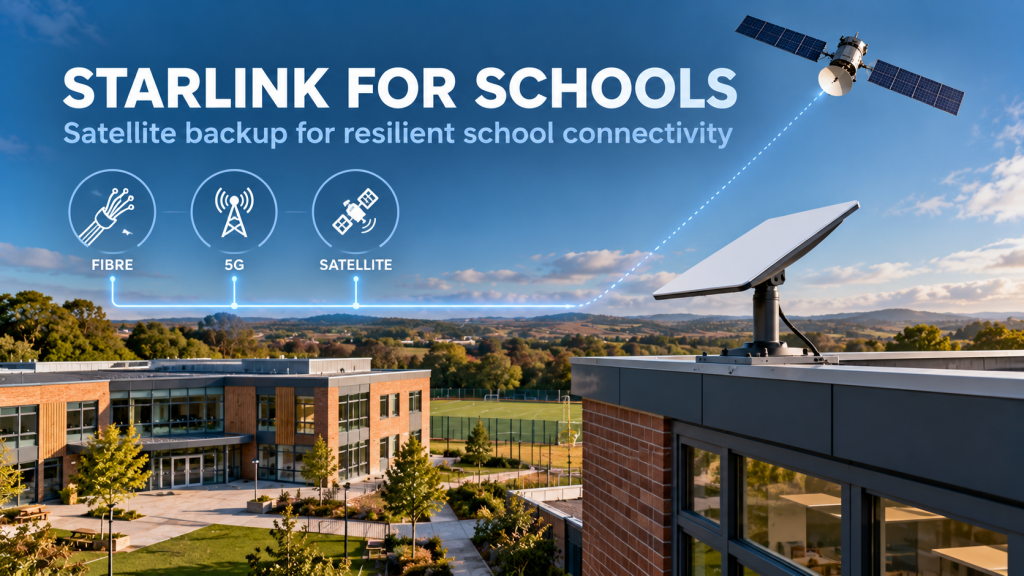
Schools now run on the internet. Cloud MIS, Microsoft 365 and Google Workspace, VoIP phones, safeguarding and filtering services, cashless catering and parent communications all stop when the connection drops. The Department for Education’s broadband standard now says schools and colleges should have a backup connection of a different type, and it names FTTP combined with low Earth orbit satellite as an example. This guide explains what the DfE standard says, how Starlink works as a school backup, what satellite as a service and SD-One bonding add, and where a satellite backup can cost less than a second leased line.
Starlink for schools at a glance
| The requirement | DfE broadband standard: schools and colleges should have a backup broadband connection of a different service type, with automatic failover and redundant power |
|---|---|
| DfE example | “FTTP combined with low Earth orbit satellite” |
| Role of Starlink | Diverse backup alongside the school’s primary fibre or leased line, not a replacement for it |
| Why satellite | Physically separate route: no shared duct, cable, street works or exchange with the primary fibre |
| Managed service | Satellite as a service from £165.50 per month + VAT, including Starlink Local Priority 50GB, Starlink antenna, 5G router with multi-network SIM, fixed IP, NOC support and SLA |
| Installation | Professional installation and site survey, £1,060 + VAT per site |
| Third path | The included 5G multi-network service gives fibre + satellite + 5G |
| Best fit | Primary and secondary schools, colleges and Multi-Academy Trusts standardising resilience across an estate |
What the DfE broadband standard says about backup
The DfE publishes digital and technology standards for schools and colleges in England. The broadband internet standards, last updated on 16 September 2026, include a standard that schools and colleges should have a backup broadband connection to ensure resilience and maintain continuity of service.
The technical requirements to meet it include:
- Multiple broadband services of different service types, for example a leased line combined with FTTP, or FTTP combined with low Earth orbit satellite.
- Multiple routers and appropriate router configuration to provide automatic failover to backup services.
- Redundant power options on core active network equipment.
The same page sets the primary connection expectation: primary schools should have a minimum of 100Mbps download and 30Mbps upload, and secondary schools, all-through schools and FE colleges should have capacity for 1Gbps download and upload. Schools should also have a content filtering system that meets the online safety requirements of Keeping Children Safe in Education, and a firewall as part of their internet and network system.
The message is clear. Fibre stays as the primary connection, and the backup should be a genuinely different technology. Low earth orbit satellite is named in the standard itself.
The Schools Gigabit Broadband programme
Alongside the standard, the DfE’s Schools Gigabit Broadband programme aims to ensure all schools in England can access a fibre connection by the end of 2030, backed by a £325 million budget for the 2026 to 2030 financial years. The DfE began contacting qualifying schools in September 2026. Schools remain responsible for buying their own broadband service from an internet service provider of their choice, so resilience on top of that new fibre is still the school’s decision.
Why a second cable is not a second route
Many schools already have two connections and assume they are resilient. But two fibre circuits often leave the building through the same duct, run under the same road and terminate in the same exchange. One digger, one flooded chamber or one exchange fault can take out both.
Satellite does not share any of that. The backup path goes up, not under the road.
Three different routes into one school: fibre under the ground, satellite through the sky and 5G over the mobile networks.
What is Starlink and why it suits school backup
Starlink is a satellite internet service operated by SpaceX. Traditional satellite broadband uses geostationary satellites around 35,786 km above the equator, which adds noticeable delay. Starlink uses a large constellation of low earth orbit (LEO) satellites much closer to the ground, so latency is far lower and everyday cloud applications, Teams calls and VoIP work in a way older satellite services could not manage.
The Starlink terminal tracks satellites electronically as they pass overhead, so there is no dish to align and no moving parts to maintain. To the school network it is simply another WAN connection on the failover router.
For business and education, the relevant service is Starlink Local Priority, which gives network-prioritised data for fixed sites within the UK, rather than a consumer residential plan.
Satellite as a service: Starlink without the headaches
Buying a Starlink kit and plugging it in is not the same as having a managed backup that meets the DfE requirements. On its own, standard Starlink has some well-known limitations for organisations:
- No fixed public IP address that stays with the school.
- No built-in failover to another connection.
- Limited remote management and visibility for IT teams.
- Consumer-style support rather than an SLA.
Satellite as a service solves those by wrapping Starlink in a managed package on a single monthly price, with no hardware to buy up front. A typical managed Starlink package includes:
- Starlink Local Priority satellite data
- Starlink Standard antenna
- 5G router with a multi-network SIM
- Fixed public IP address
- Network Operations Centre (NOC) service desk support
- Service Level Agreement
The engine behind this is an overlay platform called Continuum Constellation. It sits on top of Starlink and adds what organisations need: fixed public IPv4 addresses, 5G failover or bonded WAN options, site-to-site VPN and SD-WAN capability, and remote management, quality of service and control of the hardware. Because the package includes a 5G router and multi-network SIM, the school gains a third route on top of fibre and satellite. If you need help with the router side, see our guides to the 5G backup router and 5G router public IP.
SD-One: bonding fibre, satellite and 5G together
Failover switches to the backup when the primary drops. Bonding goes further. SD-One is a connection-agnostic bonding platform that combines several connections, such as fibre, Starlink and 5G, into a single connection with a single fixed IP address. Its key capabilities are:
- Real-time failover: if one connection fails, traffic carries on over the others without sessions dropping, so a VoIP call or video lesson does not cut out.
- Connection-agnostic bonding: fibre, FTTP, satellite and 4G/5G can be combined, all presented behind one fixed IP address.
- Application prioritisation: VoIP, MIS and safeguarding traffic can be prioritised over less critical traffic when capacity is reduced.
- Proactive monitoring and monthly optimisation.
- AES256 encryption and SD-WAN capability.
- Bonding options from 100Mbps to 2.5Gbps.
The same SD-One 5G technology is already used at scale in hospitality, keeping card payments, phones, cloud systems and guest Wi-Fi running across hundreds of sites when fixed lines fail. For a school, that means the network keeps one public identity whichever route is in use. That matters for cloud filtering, remote access, VPNs and safeguarding systems that rely on a known IP address.
Is there a cost saving compared with a second leased line?
Often, yes, if satellite replaces the backup circuit rather than the primary fibre. Many schools and trusts pay for a second leased line or a second fibre circuit that sits idle most of the year, and may not even be truly diverse.
Published 2026 UK pricing puts a 100Mbps leased line at typically £150 to £400 per month and a 1Gbps line at £350 to £750 per month in urban and suburban areas, rising to £650 to £1,200 in rural areas. Lead times are commonly 60 to 90 days, and excess construction charges can add thousands where new ducts are needed.
| Illustrative 12-month comparison | Second leased line as backup | Managed Starlink as backup |
|---|---|---|
| Primary school | 100Mbps line at £250/month = £3,000 a year | 50GB plan at £165.50/month = £1,986 a year |
| Secondary school | 1Gbps line at £500/month = £6,000 a year | 500GB plan at £321.50/month = £3,858 a year |
| Route diversity | May share ducts, roads and exchanges with the primary | Completely separate path through the sky |
| Third path included | No | Yes, 5G multi-network |
| Lead time | Typically 60 to 90 days | Survey and install, typically much faster |
Prices exclude VAT. In this example the ongoing saving is around £1,000 a year for a primary school and over £2,000 a year for a secondary school. A one-off installation of £1,060 + VAT per site applies, so the full saving starts from the second year in these examples. Every site is different, and your own leased line contract and early termination terms will decide the real figure.
Two points worth being honest about:
- Keep fibre as the primary. The DfE standard still expects full fibre for the main connection. Satellite is the backup, not the replacement.
- A backup does not need to match the primary. A 1Gbps leased line backup is rarely used. Satellite with application prioritisation keeps the essential services running during an outage at a fraction of the cost of mirroring the full primary capacity.
Managed Starlink pricing for schools
| Plan | Starlink Local Priority data | Per month (12-month term) |
|---|---|---|
| Satellite backup 50 | 50GB | £165.50 |
| Satellite backup 100 | 100GB | £190.95 |
| Satellite backup 500 | 500GB | £321.50 |
All plans include the Starlink Standard antenna, 5G router with multi-network SIM, fixed IP, NOC service desk support and SLA. Installation is £1,060 + VAT per site. Longer terms and larger data plans are available on request. All prices exclude VAT.
For most schools, a 50GB or 100GB plan covers normal backup use: occasional outages, failover testing and keeping essential services running. Secondary schools and colleges wanting to run full teaching activity for a day or more on the backup should look at the 500GB plan.
Safeguarding and filtering still apply
A satellite backup must never become a way round the school’s filtering. Starlink should connect into the school’s failover router and firewall as a second WAN connection, so the same content filtering, firewall rules and monitoring apply whichever connection is active. Pupils should never connect directly to a Starlink Wi-Fi network. A fixed IP address also helps here, because many cloud filtering and safeguarding services identify the school by its public IP.
Do not forget the power
The DfE standard also asks for redundant power on core active network equipment. Two internet connections are no use if the firewall, switches and Starlink terminal all switch off in a power cut. A proper resilience design includes UPS protection for the Starlink terminal, failover router, firewall, core switches and VoIP equipment.
A standard design for Multi-Academy Trusts
For a Multi-Academy Trust, satellite backup becomes a repeatable platform rather than dozens of separate projects. A trust can standardise the hardware, installation, firewall integration, failover and prioritisation policies, monitoring and support across every school, with one monthly cost per site and central visibility for the trust IT team. Schools that are hardest to reach with diverse fibre benefit the most.
What a school needs for Starlink backup
- A clear, largely unobstructed view of the sky for the Starlink antenna.
- A secure roof, wall or ground mounting position with safe access.
- A cable route from the antenna to the communications room.
- Integration with the existing firewall and filtering.
- UPS protection for the core network equipment.
- Failover and failback testing as part of commissioning.
Frequently asked questions
Can UK schools use Starlink as a backup internet connection?
Yes. The DfE broadband standard for schools and colleges in England says schools should have a backup broadband connection of a different service type, and gives “FTTP combined with low Earth orbit satellite” as an example. Starlink is a low earth orbit satellite service.
Does the DfE require schools to buy Starlink?
No. The DfE requires a resilient backup connection using a different service type, automatic failover and redundant power. Low earth orbit satellite is one named example. The right option depends on the site.
Can Starlink replace a school’s leased line?
Not as the primary connection. The DfE expects full fibre as the primary service, with at least 100Mbps download and 30Mbps upload for primary schools and 1Gbps capacity for secondary schools and colleges. Starlink is best used to replace or avoid a second leased line used as backup.
How much does Starlink for schools cost?
A managed Starlink backup service starts from £165.50 per month + VAT on a 12-month term, including Starlink Local Priority 50GB, the Starlink antenna, a 5G router with multi-network SIM, a fixed IP, NOC support and an SLA. Installation is £1,060 + VAT per site.
What is satellite as a service?
Satellite as a service is a managed package that bundles the satellite connection, antenna, router, fixed IP, support and SLA into one monthly price, with no up-front hardware purchase. It turns Starlink into a managed business connection rather than a self-installed consumer service.
What is SD-One?
SD-One is a connection-agnostic bonding platform that combines connections such as fibre, satellite and 5G into one connection with a single fixed IP address. It provides real-time failover without dropping sessions, application prioritisation, monitoring, AES256 encryption and SD-WAN capability.
Does Starlink bypass school web filtering?
Not when installed correctly. Starlink should connect to the school’s failover router and firewall as an additional WAN connection, so the same filtering and security policies apply whichever connection is active.
Check your school’s resilience
What happens to your school when the main internet connection fails? If the answer is that phones stop, cloud systems disappear and teaching is disrupted until the circuit is repaired, there is still a single point of failure. Tell us about your school or trust, your current connections and contract dates, and we will show you how a satellite backup with 5G compares. Email sales@5grouter.co.uk.
For remote equipment rather than whole sites, see our guide to satellite IoT from £30.50 a month.
Prices exclude VAT and are correct at October 2026. 12-month minimum term. Service is subject to site survey and a clear view of the sky. Leased line comparisons are illustrative and based on published typical UK pricing.
Planning a deployment, or stuck with one that is not behaving? Email sales@5grouter.co.uk with the site, the equipment and what you need it to do.
Leave a Reply